

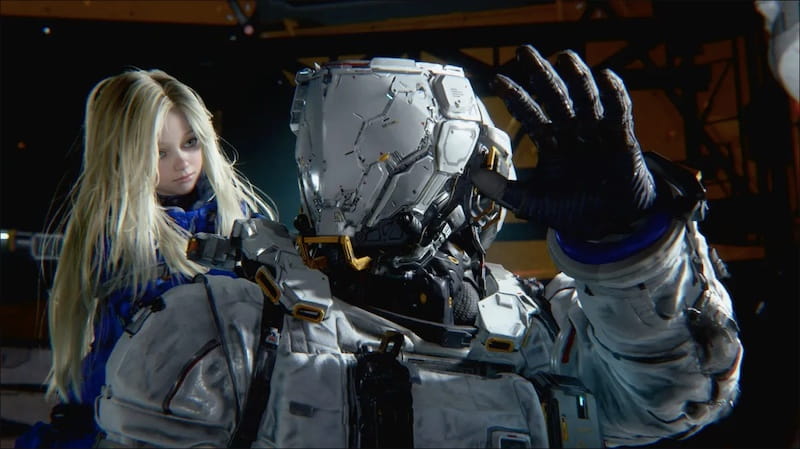
Pragmata PS5 Hands-On Preview. This is the third time I’ve actually gotten hands on with Capcom’s sci-fi epic Pragmata, and each time, I find myself thinking that Diana might just be one of my favourite companions of recent memory. The pint-sized android buddy – who is a key component in combat thanks to her ability to hack foes to exploit their weaknesses – is more than just a means to an end for protagonist Hugh; she may not be human, but she’s curious, insightful, chatty, and oozing with personality. Capcom clearly want you to pay attention to the bond between Diana and Hugh, as it’s believable and feels natural – it’s just a well, as it lends the game a lot of charm.
Pragmata PS5 Hands-On Preview – Me And My Android Buddy
Capcom’s latest Pragmata demo allowed us to explore a much larger area than before, namely a recreation of New York City nestled on it sprawling moon base, presumably to give its occupants some semblance of life back on Earth. Before that though, I was allowed to tinker with Hugh’s abilities and loadout in the Shelter; a safe haven that you can return to at specific points using a fast travel system that serves as your upgrade station, and also a means of bonding with Diana. Popping into upgrade menus, there’s the usual assortment of weapon and suit upgrades, giving you more HP and buffing the stats of your guns, but things a go a bit deeper than that.
You can also boost the likes of Hacking, Repair Up, Thrusters, Mod Slots, and Med Slots, which all contribute to your survival in meaningful ways. Mod slots in particular are very important as they can give you buffs to attack, hacking, and defense, which come in handy during combat, while anything that improve hacking is vital to give you the edge as AI-powered sentinels close in on you.
Lunafilament spills by the bucketload after defeating enemies for example, and is your basic upgrade resource that is complemented by other pickups used to buff your suit and primary unit (your standard firearm of choice that refills ammo automatically after a few seconds). I found myself travelling back to the Shelter a few times during my hands-on just to take a look at what other upgrades I could afford, or to beef up some of the newly-acquired weapons I nabbed out in the field. It’s a nice break from the meat-and-potatoes of exploring and fighting enemies, giving you a chance to plan your next route, catch your breath, and invest in Hugh’s abilities
One of the best upgrades I dropped some Lunafilament into was the Critical Shot ability, which appears on the hacking grid from time to time and dishes out major punishment. This comes in handy against more powerful enemies beyond your standard grunts, and combined with everything else, made me feel like Hugh was actually getting stronger and therefore worth investing in.
It’s not just Hugh that benefits from popping back to the Shelter, either. Here, you can also chat to Diana and get to know her more, satisfying her curiosity by bringing back gifts for her (such as a globe) that she can look at and dissect in her own loveable way. She’s also quite chatty during gameplay, punctuating the quieter moments with banter as she grills Hugh about everything and anything. From the look of things, character development between the pair is something that will be a major focus, and I’m all for it.
The main loop of my hands-on demo was unlocking a large door out on the ‘main street’ area, which is done by hacking six beacons linked to each lock. It’s here that Pragmata opens up a bit more than previous levels I’ve played, as it’s a much bigger location that eschews the linear corridors of my earlier hands-on.
The beacon are split up and require you to hunt them down while battling against numerous robotic foes (hitting Square activates Diana’s scan to show you a rough location of the nearest beacon), and it’s a refreshing change to being funnelled through white halls and pathways. The fake New York is sprawling, comprised of streets, multiple buildings, neon-soaked signs, and beautiful lighting, with verticality a major focus.
Pragamta’s combat loop is something I’ve touched on previously as being incredibly addictive and rewarding, and that hasn’t changed at all. Squeezing L2 to bring up the hacking grid and hammering the face buttons to navigate panels to exploit a foe’s weakness is smooth and responsive, and your guns have a weighty punch to them.
When hacking, you can also gain bonus damage and other buffs by hitting other nodes on the hacking grid, and therein lies a nice wrinkle of strategy. A grid may have plenty of damage buffs, but do you have time to hit them and exploit the enemy’s weakness before they close in on you? Is it best to go for a quick few shots or risk taking damage yourself by becoming too greedy? It’s a welcome balance that I found is really emphasised as you come up against more powerful enemies.
Speaking of which, scrapping with new foes really helped to shake things up in terms of how you approach scraps. For example, there’s airborne foes that chuck projectiles at you that work as a distraction as on-foot behemoths close in on you to dish out the main punishment. One in particular, a lumbering humanoid several meters taller than you, is able to deploy radar-like shields on its face to scramble your hacking efforts; these must be dispatched if you are to effectively access their weak point.
This really adds a new dimension to combat and had me having to adjust my strategy on the fly, switching between targets to prioritise the biggest threat. As such, battles can become quite heated and require a lot of strategic thinking of the player’s part, and thus reveals just how deep the combat can go as you are constantly switching weapons, tactics and hacking opportunities while facing down multiple opponents.
Eventually I managed to unlock the door and progressed through to the area beyond, only to be met with a hulking, multi-limbed robot baddie that served as boss fight and the conclusion to the demo. This mechanical behemoth pretty much put Hughs entire skillset, but still managed to strike a solid balance between challenging without proving too overwhelming; its attack patterns are quite telegraphed, but their area of effect ensures you are constantly on the move, taking precious seconds to hack the towering enemy and score some crucial damage. It’s thrilling, action-packed, and as epic as you’d expect from Capcom at this point.
Having played Pragmata three times now, Capcom’s upcoming sci-fi epic is slick, stunning to look at and above all, fun to play. The larger environments and diverse enemy lineup keeps things fresh, and proves that its unique combat loop isn’t gimmicky and remains as addictive as when I first played it. Hopefully the relationship between Hugh and Diana continues to expand throughout, as it was a highlight of my session and clearly a main focus of the narrative.
Pragmata is out on PS5, PC, Nintendo Switch 2, and Xbox Series X/S in April 2026.